Grok's New Year Body Horror
Elon's AI has a surprise for you :)
I took a few days off to have fun with friends and family last week. “What discourse could happen in the meantime that I would really regret skipping?” I thought, possibly at the same time an unassuming patch of shrub in my city burst aflame.
Several days ago feels like it might as well be 10 years ago. It seems absurd that not two weeks have passed since I got a push notification from my ghost town of a Twitter account while my family scrambled to find a New Year countdown. “Grok has a surprise for you,” it said. After the apprehension that the notification might be for some kind of violent disaster subsided (those would come the next morning), my curiosity won over.
Now, look. It’s not like I expected much. Grok was introduced in 2023 by dweeb-in-chief Elon Musk as “a maximum truth-seeking AI that tries to understand the nature of the universe,” a combination of words designed, like everything else he says and does, to disguise the vacuousness at their core with verbal symbols of grandeur. “Maximum truth-seeking” is not a scientific phrase, and neither is “understand the nature of the universe.” These are human abstractions, not quantities a machine is capable of computing.
So far Grok has distinguished itself among its competitors by being hopelessly cringe. Its “Fun Mode,” which was finally euthanized last month, was sold as a chatbot with “a rebellious streak,” designed to “answer questions with a bit of wit,” ho ho. “We worked had to ensure Grok was funny,” tweeted Elon, which was an immediate red flag. Mostly this “humor” amounted to Grok calling you “dear human” before solemnly telling you that in a pinch, horse manure can act as a perfect thickener for your cookie batter, or whatever AI is saying these days.
Anyway, I opened the notification and, after the reading the prompt written for me, enjoyed a brief bit of nostalgia watching the images print themselves out bar by horizontal bar the way image downloads used to in the dial-up days. Aww.
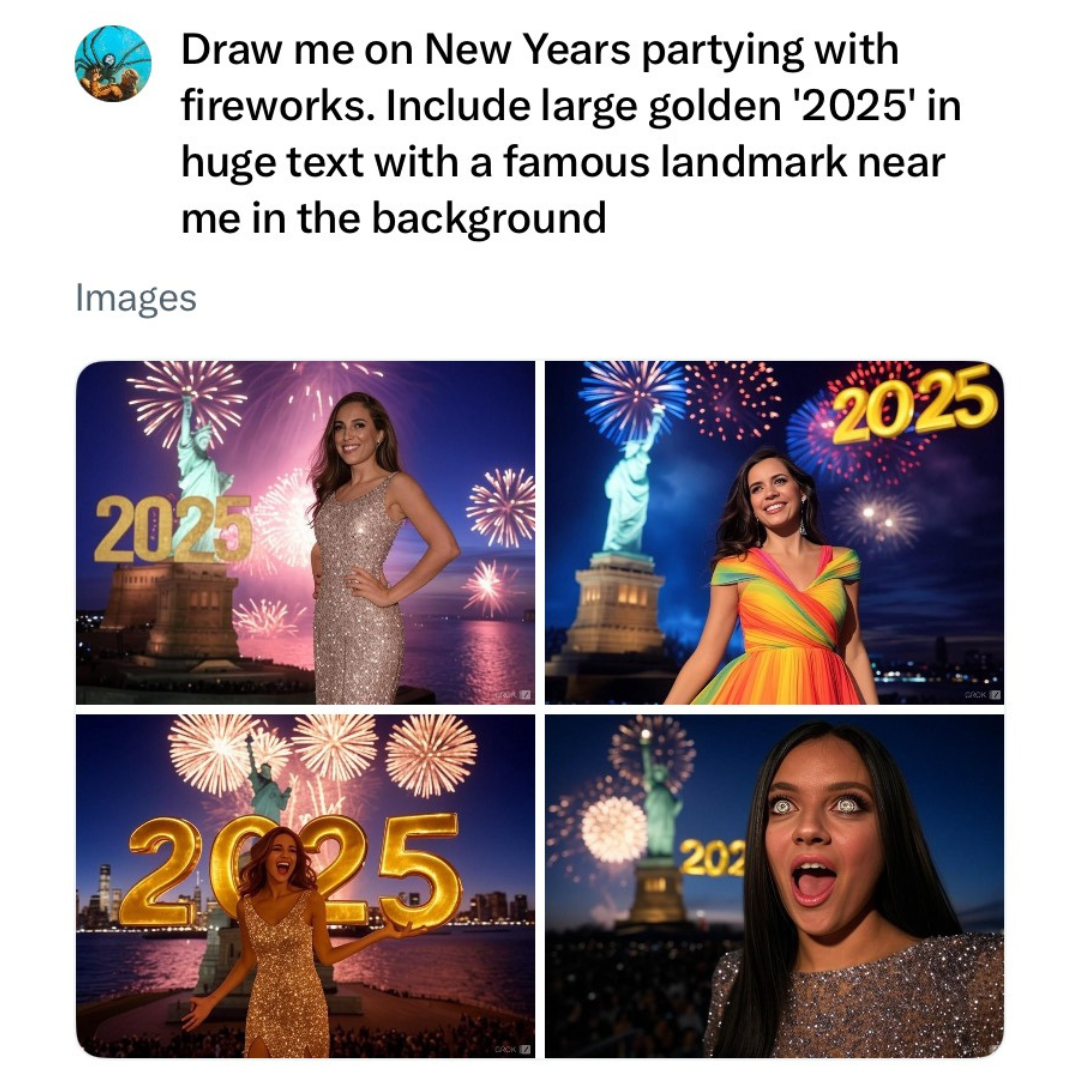
Hmm.
So, first thing’s first: many of the people who will read this know what I look like enough to know that obviously none of these people are me. This makes sense, because I don’t upload much visual information to anything on the internet except YouTube, certainly not to X. Why would I? Musk doesn’t seem to understand that his everything-app goal can’t happen unless people have the motivation to use it as such, which motivation he has so far studiously refused to provide. As if that’s somehow our responsibility. Twitter is not the pictures app. Twitter is the words app. There’s already a pictures app, it’s called Instagram.
However, this does provide an interesting opportunity to peer into the sausage factory of AI. What visual rhetoric is available to a system that needs data from its target audience to function as intended, but hasn’t been given any? Grok gets that I’m female, and that the name “Mariana” might imply some ethnic ambiguity, but beyond that it has no idea what to do except recreate today’s most basic beauty and fashion standards. It’s CW soap opera star by way of Temu. That would all be unremarkable on its own, but then I remember that this is supposed to be me, and then I start to notice that top-left Mariana Contender’s eyes are pointing different directions and bottom-left Mariana Contender has painfully deformed arms and hands and there is suddenly activated in me a primal rage only the uncanny can provoke. I want to shred these pretenders at my identity, tear them apart with a passion beyond all reason.
I’ve taken a look at some of the images of other people Grok generated in cybernetic cheer and good health and have noticed some similarities frankly embarrassing for any device that claims to be “generative.” The “famous landmark” somehow almost always ends up being the Statue of Liberty or the Eiffel Tower. Unless the account either uploads a lot of selfies for some reason or centers around some kind of easily imaginable character with pre-rendered examples, say, “@ScubaPossum,” the results are very unlikely to come out looking anything like you (one white supremacist account I found was miffed when Grok imagined her as a black man).
Instead, it’s likely to hand you a series of Instagram models, carefully posed, with the kind of staged excitement only people chasing a Lululemon sponsorship can conjure. The prompt says to show me “partying,” but I see no party here. There is no crowd of friends and no music. There is certainly no booze. I’ve never been to a party that looked anything like this.
The glittering stilted sameness that characterizes AI imagery makes its “good” results as trashy as its bad. The practical argument against AI usually has something to do with its data supply being as limited as the potable water it guzzles—eventually, AI will have nothing to scrape but its own results, making its outputs progressively worse. That’s true, but it’s just as true now as it will be when it has nothing to harvest but itself. AI is not “generative,” it’s recombinant. The difference is a matter of meaning-making, which only humans are capable of. Recombinance rearranges preexisting pieces. Any idiot can do that. Generativity, though, is a matter of creative interpretation. The few times AI produces something that seems interesting, it’s only because we’re interpreting it as such. Our own perspective is the final ingredient that turns a bunch of random data points into something more than the sum of its parts.
The only status quo AI has disrupted is the idea that creative experiences are made richer if this interpretive process is also held by the artist. Perhaps the most noxious lie produced by modern society is the implication that art is primarily about being pretty, or complicated, or “accurate,” whatever that means. No. Art is about conversation, comparing your perspective with someone else’s. You can’t have a conversation (an inherently generative process) without someone to talk to. AI defines itself by removing human agency from a process where human agency is literally everything.
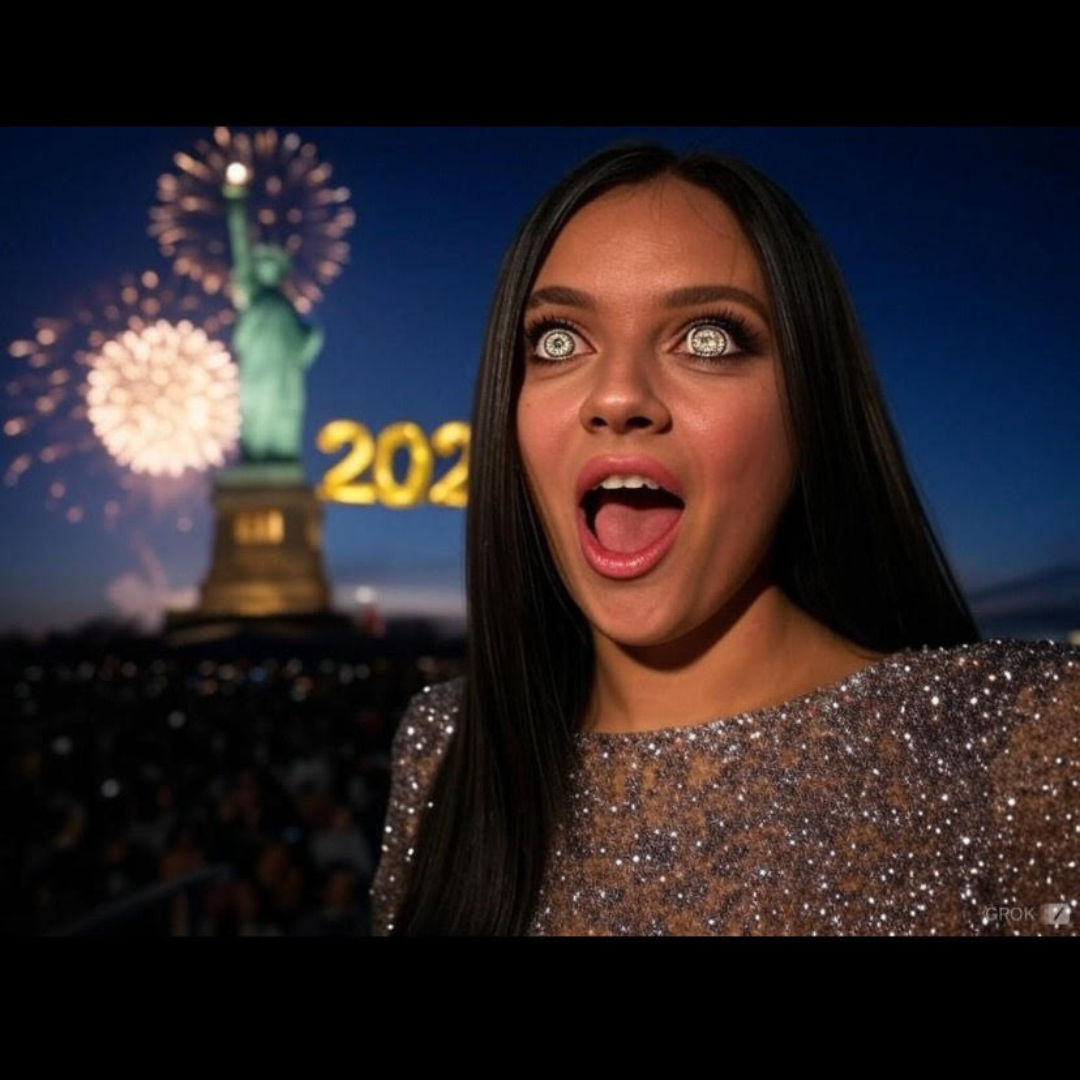
Let’s take a closer look, for example, at what I think is the most upsetting Mariana Contender:
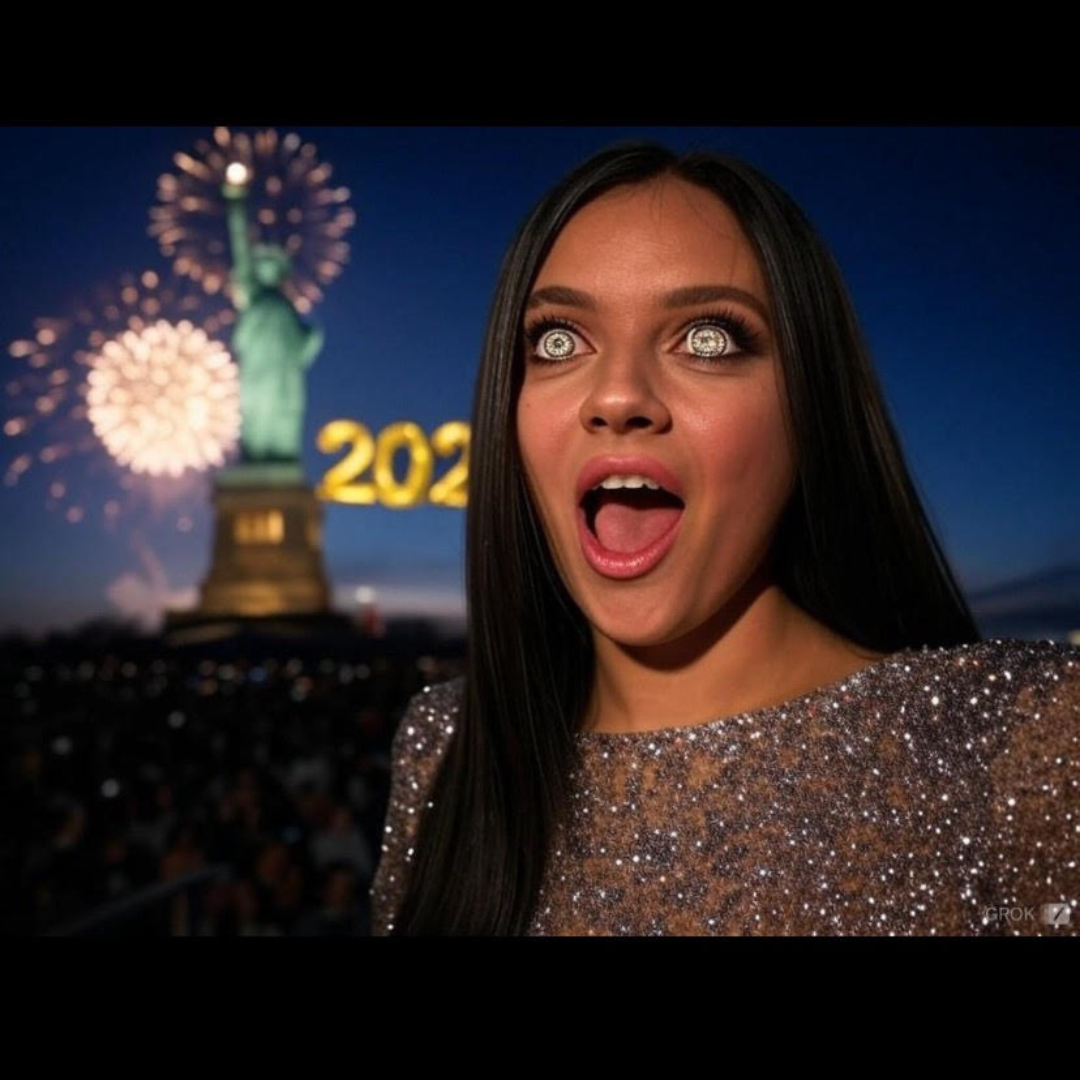
Holy Christ, what an abomination.
You can see the logic here; it’s the only image is this slate that can be at all understood as creatively inspired. “Wouldn’t it be fun if the fireworks were reflected in cyber-Mariana’s awestruck eyes?” But because the image must also include “famous landmark” and “large golden ‘2025,’” and because this imposter needs to have an expression that says “VERY PARTY FUN” to make up for the clear lack of party surrounding her, the frame is way too wide. The only possible way the fireworks could read as fireworks in the eyes of this not-me is if this were a super-closeup, the eyes taking up most of the frame. But this is a level of creative intimacy Grok is incapable of intuiting. As it is, the jumbling of concepts makes the image read more like this poor woman who isn’t me has been colonized by some kind of manic digital body-snatcher who causes one’s eyes to turn into TV static. Maybe she’ll swallow me whole. Look at me. I am the Mariana now.
The hawkers of this machine want you to believe it’s a rare and delicate magic. It isn’t. It’s an expensive party trick. It’s David Blaine telling you your social security number with a bug in his ear. Behind the mystical incantation is a vast, elaborate, industrial mechanism belching smoke, willing to sacrifice anything to amuse you, dumping water into the desert and cancer into the sea all to make you clap your hands and gasp in delight. Do you feel loved?
My guess is you probably don’t. No healthy mind is very impressed with the kind of desperate adulation this kind of thing exists to provide. There’s always something a little creepy about a person who does nothing but agree with you.
LA is on fire. Meta has officially abandoned its frail attempts at content moderation. The US is closer to open war than we have been since 1940. 1940 was, by the way, the middle of the Golden Age of Hollywood, where honest attempts at artistry and beauty helped sustain a sense of purpose and hope in grim times. Today, the best our most powerful culture leaders can offer is ourselves, smoothed out and appended with what they consider the proper amount of astonishment at our increasingly unimpressive surroundings. We are being corrected for our pesky human tendency to stray from directive.
Happy New Year from me and my grinning homunculi.