Small Gods and False Prophets

Once every year or two, for a wedding, or a cousin’s first communion, I’ll find myself at Catholic Mass. It’s a sign of personal maturity, I guess, that Mass is no longer something I dread the way I did in elementary school, which was the last time I went regularly. Then, as now, I was called to church less by the voice of God and more by the unspoken threat of family ire. But something is different about the way I interact with Catholic rituals as an adult. I feel the unity of thought and intention in the air, the peace of certainty in what one both does and does not know. In short, I get it, and in those moments I wonder if maybe I’ve turned a spiritual corner. “Shit, maybe I’m Catholic,” I think. “Maybe I’ll come back next week.”
Then the priest will say something about obedience or the natural hierarchy of the universe, and I come crashing back through the walls of my own rapture, Kool-Aid Man style: “Oh yeah. I don’t actually believe any of this.”
This is a specifically academic foolishness, I think. Approaching religion or culture as an object of study can only impersonalize it, which for a long time (and still among more people than I’d prefer) was considered less a liability than a signal of competence and sophistication. The structural-functionalist anthropologists of the mid-20th century thought of culture as mostly an embellishment of pre-existing social relationships—basically, that there is a core human template over which we lay culture and all its aesthetics and rituals like a video game skin. The culture itself is immaterial, its function is to act as a machine that receives the inputs of language, fashion, technology, economics, art, and outputs whatever social framework was, I guess, pre-ordained to that culture.
The specific failures of that framework are another discussion, the point is that as a non-believer who recognizes and respects that religion is important to some people, I sometimes get lazy in a structural-functionalist way when I have to maintain why church is no longer boring to me in the context of my stark non-belief. It would be so much simpler if religion were just a means to social cohesion, common purpose, in-group care, whatever, and all the scripture were just set dressing. It would be so much easier if it nobody actually had any more faith than I do, and all the nice feelings I get when I go to Mass that once every year or two didn’t require me to sincerely believe that a man named Jesus, who was also God, sacrificed his own life in a bloody and brutal execution for my sins two thousand years ago.
Let's instead assume the opposite of structural-functionalism and consider the idea that there is no basic truth of the human condition— no pre-existing social structure, humanity makes its own rules. This is easy to imagine because it’s almost certainly true. Religion, in this context, becomes a potent vector for social control. I’m obviously far from the first person to arrive at this point. Nonwhite scholars and activists have been asserting this for centuries as an argument for the inherent moral rot of colonialism. The more, uh, optimistic version of this analysis is well-represented by someone like Jordan Peterson, who has stated publicly, onstage, in front of a live audience of hundreds and a digital audience of millions more, that religion is primarily valuable for its ability to command morality among people who are too stupid to understand morals otherwise.
Anyway, this is what Small Gods is about. Terry Pratchett published this book in 1992, which makes it extra remarkable since that was a time in which white British guys had even less of a practical reason to care about these things. On the Discworld, gods are fueled by belief in such a literal way that when the Great God Om descends upon his theocracy to make his scheduled appearance before a new prophet, he finds the only power he can successfully muster is as much as is required to appear in the form of a small and ordinary tortoise. The city of Omnia revolves around religious ritual, but the well of true belief among his followers has run dry. His last true believer is an unintelligent young initiate named Brutha, whose simple mind has, apparently, left him the only one dumb enough to think everyone was taking this seriously.
Brutha ends up being the new prophet in the end. Of course he does. It wouldn’t be a good story if he didn’t. Terry Pratchett only writes good stories, so Brutha must be the prophet, simple as that. To be sure, Brutha’s dullness is doing a lot of work to pull this off. A smarter character might see the way the pieces are moving and clock his own position in the narrative, realize his actions are scripture-in-the-making, and thereby ruin everything.
It's easy to read Pratchett’s clear disdain for the fruitless self-obsession this knowledge would naturally become as a send-up not only of organized religion, but of the lack of intelligence required to buy into it. According to Pratchett himself, though, adherents to organized religion often seem to find just as much meaning in Small Gods as apostates. To them it is less an image of the tiger traps of religion itself than of religion practiced wrongly. Letters to him about the book, he said, were “split between 1) pagans who say that it really shafts the Big Beard In the Sky religions and 2) Christians who say that it is an incredibly pro-Christian book. I suspect the latter is because Brutha displays tolerance, compassion, charity, steadfastness and faith, and these are now considered Christian virtues (i.e., virtues that modern Christians feel they should have)."
“Modern Christians” here is in implicit opposition to past Christians (and, for that matter, future Christians, many of whom have explicitly abandoned these virtues, at least in the US). Small Gods as a story is about nothing so much as it’s about religious standards of behavior always being subject to change. That’s because even if holy instruction is real, even if there is some great Author out there, the Message must still be interpreted by human beings, and human beings have their own motivations. We can’t even agree on what the American Constitution says, and it was written by mere mortals barely 250 years ago with very little metaphor or poetry to speak of.
This is a flatly unsolvable human problem, which I think accounts for Terry Pratchett’s apparent lack of any respect for the letter of religious belief whether Christian or otherwise (at least none that he cared to speak about publicly). What he does clearly respect is The Story, the archetypical ur-tale through which the culture to and in which he wrote communicates its knowledge about things that can’t actually be known. The Story is whatever weird thing out there makes it the case that Brutha must absolutely be the prophet even though no one is enforcing this convention. Like a god, The Story is an immanent thing, encountered through experience rather than cold intellect. The Story can only be told obliquely, and only perceived out of the corner of one’s eye. When you look directly at The Story it disappears and becomes analysis, objectification, appraisal. These things are fine (they’d better be, they’re my job), but they are not the same as The Story. The Story is only itself.
One of the genuinely divine things about The Story is that it occupies an impossible space where everything is simultaneously always changing and still, somehow, has always been true. Religion, for this reason, has a permanently ambivalent relationship to The Story. On one hand, The Story resists doctrine. Being a thing that’s easily bored, it vanishes as soon as it catches a whiff of dogma, or any suggestion that events should play out in any other way than the way that feels right in the moment. On the other hand, without The Story there would be no religion at all. Revelation, whether spiritual or secular, is a thing that only emerges in a position of pure openness to whatever you encounter in the world, free of preconception. As a function of The Story, revelation cannot be controlled or predicted, but I think under certain circumstances it can be induced. Brutha and Om were deep in the desert before it landed on me that their bickering and slightly panicky journey back to Omnia was Brutha’s prophetic pilgrimage, a believer encountering his god in the wilderness, being changed and changing the world as a result. Brutha himself, being at least a little dumber than me, doesn’t realize this until he’s back home. This experience, shared by both Brutha and myself, is The Story at work, a series of events that absorbs your attention such that in the moment it can only be experienced, not thought about. The meaning only snaps into place later, often once everything is already done.
This is the wildness of human experience organized religion both relies upon for devotion and fears for its unpredictability. Intuitively, it’s easy to think social control breeds belief. This is the cynical approach to religion assumed both by its worst practitioners and its critics, many of whom would like to think people only believe unprovable things under coercion or manipulation. I disagree: I think true metaphysical belief and vulnerability to social control are, in fact, inversely correlated. They are not mutually exclusive, but their coexistence is always unstable. This is because belief requires you to think of your own life in terms other than those set by people more powerful than you, who are, regardless of power, still only people at the end of the day. Faith is an encounter with the self, more than anything. If you’re a believer, your god (who- or whatever it is) is at its foundation the force that animates your soul. It’s the part of you that demands conversation, that makes you negotiate your relationship with yourself as well as your place in the world around you.
It's that last part, the negotiation part, that’s important here. People who seek to control others through religion are typically smart enough to decenter themselves in their public theology. This is all about you, they say, your inner life, your immortal soul at risk, any holiness they might have is just a function of their willingness to generously share their wisdom. Sorry to bring up Jordan Peterson again, but he really is the modern icon for this sort of thing (plus he’s currently laid low, beset with yet another esoteric mystery illness, of the body or soul who can say, the man loves to suffer almost as much as I love to kick him while he’s down. See how the kind universe puts everything in its proper place?). Peterson is fond of defining God (big G, the Christian God) as your conscience, the little voice within that seems to come from elsewhere and allows you to maintain a running conversation with yourself.
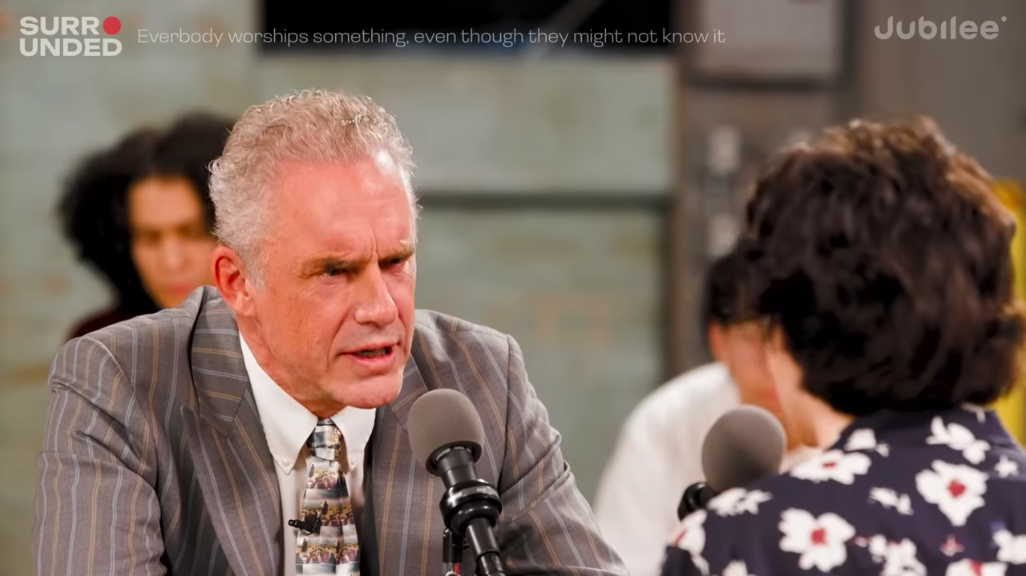
You’ll notice that’s almost exactly how I just defined god (small g, the eternal and nondenominational unknowable). The difference between Peterson and a heathen postmodern neomarxist like myself is that Peterson, who seeks to control others through religion, will try to convince you that your conscience is an object to be sequestered and protected lest it be confused and led astray. “At the center there is truth,” says Omnian tyrant and false prophet Vorbis to Brutha. “As you travel, so error creeps in.”
The argument here is that whatever divinity is animating the human mind is born perfect, and in a gnostic way can only be corrupted by further knowledge of the world around oneself. As Vorbis says: “There are some things which appear to be the truth, which have all the hallmarks of truth, but which are not the real truth. The real truth must sometimes be protected by a labyrinth of lies […] Things that are seen and heard and done by the flesh are mere shadows of a deeper reality.” This is the point of Jordan Peterson’s campaign to convince people they’re actually Christian whether they accept Biblical scripture or not. His Jungian theological slurry, his bargain basement literary analysis, functions under an assumption that the individual mind is literally God, and anything that disrupts the sacred certainty of that holy inner voice must be treated as a threat.
In the proud tradition of right-wing accusations being confessions, this is pretty clearly atheism to me. Not serious atheistic philosophy, but atheism’s clumsiest and most juvenile caricature, exactly the self-worship Peterson would describe as something we “entertain at our great peril” or with some other pompous pigshit language. Peterson believes in nothing but the power of symbols to move people around. His piety is a performance curated for the benefit of his own control over others. He is a person who “[talks] to himself, and [listens] to himself […] all Vorbis could hear were the distant echoes of his own soul.”
I mean, listen, it’s not that I’m any better. I can’t say with any honesty that I hear the Christian God as such speaking to me when I’m in Mass. I don’t even know what that would sound like. But I do know that whatever I’m feeling when I sit there awash in the rhythm of the sermon, the voices in song, the earnest wishes of my neighbors that peace be with me, whatever I’m feeling when I sit there, getting it, is not exclusive to the building I’m in. I feel it as acutely in Mass as I do at a good party, or when I’m given food from a plant or hen whose happiness I’ve taken responsibility for, or when I’m in a position to share people’s grief or fear, and in doing so, feel like I'm helping support its weight. It’s when I’m struck with the sense that there’s a plot, and that I’m in it, but I can’t see where it’s going because other people and creatures are in it too. What a miracle, what a humbling privilege to experience this thing that, in certain unexpected small and large moments, feels so much like a voice.
***
This article was commissioned by a very generous Patron at Patreon.com.