Some Thoughts About The Bone Temple
Earlier today, ICE agents in Minneapolis shot VA nurse Alex Pretti 10 times and killed him. The last thing he ever did, the act that signed his death warrant, was try to help a woman ICE had pushed to the ground. “Boo hoo,” one of the agents spat as he stalked around and glowered at the swelling crowd.
In the hours following this summary execution of an American citizen by his government, that government has been on one of the most spectacular spin campaigns yet in an administration whose primary goal seems to be outdoing the previous day in delusion, self-congratulation, and clownish, simpering, faithless, boorish bullshit. For committing no crime visible from the many angles the event was shot from, Pretti’s government has called him a “domestic terrorist” and “would-be assassin,” the legal gun he had on him when the agents forced him on his knees and murdered him now evidence of “a situation where an individual arrived to inflict maximum damage and kill law enforcement.” This event, and ICE’s murder of Renee Nicole Good two weeks ago, is part of an excruciatingly slow rollout of consequences set by the cultural conditions of the past couple of decades. It feels almost as if history is procrastinating, but history probably always feels that way when you’re living through it.
Among other things, we’re in a war of symbols. The worst among us have clocked the growing fissures between shared meaning and material reality as an opportunity. Those people have wriggled out of their proper place in the damp, dark recesses of human impulse and id to announce their time has come. The truly wild thing about the claims to legitimacy that seep hourly out of the mouths of people like Donald Trump, Greg Bovino, Kristi Noem, Stephen Miller, pick your shithead, is that they are utterly disconnected from any obligation to even acknowledge that people have eyes, and can use them to see things. Their appeal is not to people’s hearts or minds, but to our capacity to be bamboozled, to be so stunlocked by spectacle after spectacle that mastery over that spectacle settles into our minds as being the only consistency worth respecting. A symbol can mean almost anything, and the person in charge is whoever sets that meaning with the most dramatic flair.
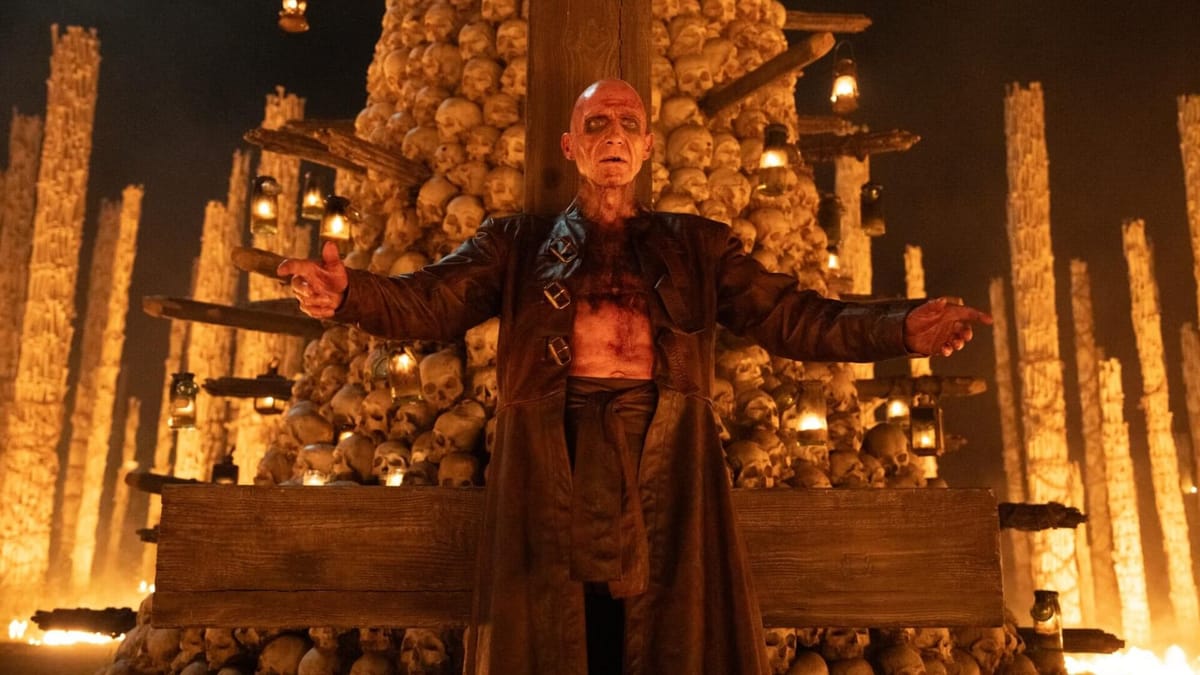
This isn’t to say that the Jimmies in The Bone Temple should be understood as allegorical or directly symbolic of this administration or any of the other similar organizations currently erupting from society’s septic tank. I think the purpose of art is generally more elegant than that. One of many reasons we’re in the situation we’re in right now is the desire to domesticate stories—to understand them not as aesthetic experiences but as elaborate moral delivery mechanisms, propaganda for those too weak and stupid to pay attention in Civics class. The Jimmies, who “rescued” Spike at the end of 28 Years Later and whose religion of open atrocity drive the narrative of this movie, are not direct representations of any one person or group of people, but a manifestation of the nihilistic absurdity that animates them—as an art piece, The Bone Temple is an expressive exercise, not a comprehensive one. Sir Lord Jimmy (Jack O’ Connell’s second icon of modern cultural pathology in the past year) is a figure clad head to toe in juvenile symbols of evil elevated into mystic significance in a world where the Rage Virus has eliminated almost all other humans from the competition for meaning-making. He is a vice signaler, a person whose claim to power is synonymous with the simple exertion of that power.
As such, Sir Jimmy’s attempt to usurp Dr. Kelson’s monument to the dead and turn it into a chintzy, obvious temple to try-hard mayhem brings with it a sort of metaphysical taint. Dr. Kelson’s life work and the secular-spiritual contemplation it was meant to inspire is cheapened by the mere fact of the Jimmies’ admiration for it. So, too, is Dr. Kelson himself. His Iron Maiden “The Number of the Beast” floorshow, while sick as hell, is not the kind of energy this structure was built to host. Its symbol has, through no fault of his own, grown out of control— the bones of its scaffolding transformed instantly from testaments to the harmonious peace of death to grisly, vulgar icons of the chaos that caused that death. All he can do is try to steer its meaning back toward safer waters by performing his own display of aesthetic dominance. Dr. Kelson is an avowed atheist, but that doesn’t mean he’s exempted from the rituals required to protect the symbols that matter to him. He serves the Temple now; he is transformed despite himself into a priest of its holy mission.
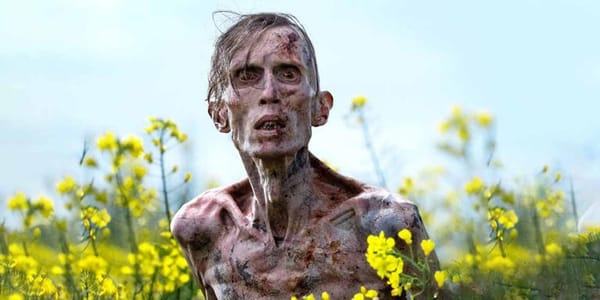
Truly, the only people absolved from respect for the role of symbols in human life in the world of this movie are the infected. In their constant pain and rage, they are counterintuitively immune to acute pain and rage, the really deep kind that only comes from having things to lose. There are two sources of savagery in this story: one that comes from a total devotion to symbols, and one that comes from having no symbols to rely on at all.
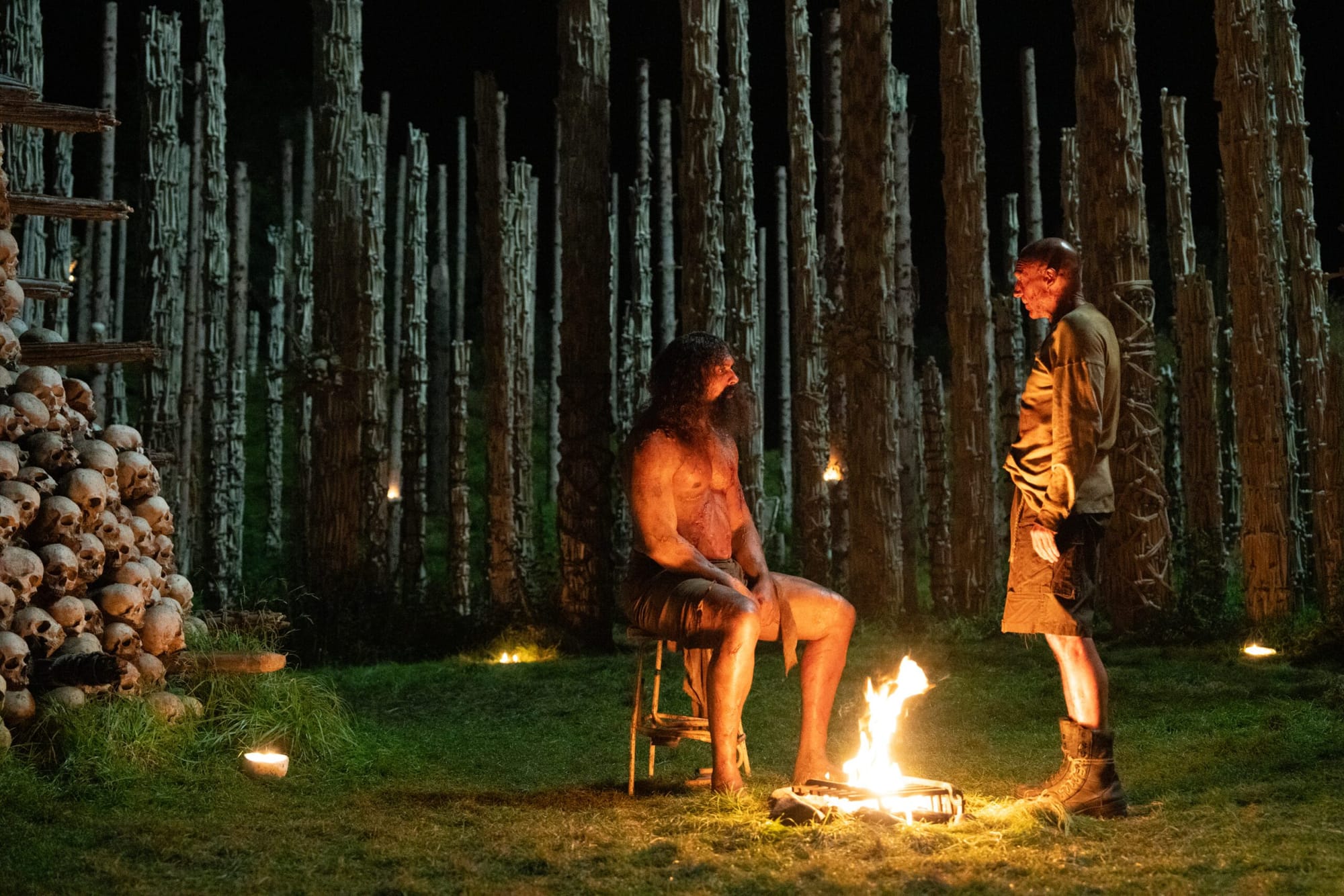
Spike’s role in all this is primarily observational. In a disconcerting subversion of the themes of 28 Years Later, he spends most of the movie silently quivering in terror, a complete upending of the confidence and poise we saw him earn last time around. Spike has entered the world of adulthood and discovered that grief and loss are just the first circle in a hell of human experience you can descend forever. He doesn’t know it, but his thematic foil in this story is Samson, the hulking infected man Dr. Kelson has been studying in hopes of finding a cure. Samson, too, acquires a new adulthood at Kelson’s gentle direction, the doctor’s kindness and sincere belief in the healing power of a mind at peace. These three pilgrims to the Bone Temple, Sir Jimmy, Spike, and Samson, triangulate each other in an oblique encapsulation of all of us who live in, act in, and witness this world in its ruin and shame and sorrow. Jimmy is internally safe in his own sick mind but externally as pathetic as he is devastating, his commitment to the supremacy of symbolism turning him into a cancer that destroys everything it touches. Spike, having properly encountered the peaceful message of the Temple’s bony spires, is morally centered but otherwise exposed, a raw nerve who can only endure so much before it snaps. Samson is simultaneously the origin and result of both. He is Jimmy’s directionless bonfire of destruction and Spike’s calm curiosity. He is the blank slate of a life without symbols and the oblivion of a life devoted to nothing but symbols. Samson is, more than anything, the volatile potential of human creativity. In his transformation at the Bone Temple he starts life anew at its most foundational human element, the source of everything beautiful and wretched our dazzling, horrifying human minds can turn the world into. One imagines the earliest humans beginning our path the same way: as a pair of eyes, gazing into the night, trying to name the moon.