The Internet Is a Workplace and We Need to Treat It Like One
How’s everyone doing? Good? Not me, thanks. My backlog of work has finally met the bottleneck of my burnout. My dog, best friend for 13 of my most formative years, is dying. Autumn, my favorite season, is turning into a more summery mush with every year that passes. I am constantly tensed against the possibility of someone in my family being beaten, detained, illegally deported. Anxiety around the Trump regime’s desperate thrashing leading up to midterms and the many potential ways they could act upon this desperation is eating up my favorite month. Seven students at an elite university raped a girl, fifty some-odd more facilitated it, and authorities covered it up for years. Then a few days into the ensuing outrage, video essayist Jacob Geller was outed as having himself been suspended from his undergrad university for committing sexual assault.
A few people have asked me to comment on this over the past week, and I’ve hesitated for a couple of reasons. Though I enjoyed his videos, I have never personally met Jacob or talked to him. Sexual assault is an intensely personal and intimate crime, and I think basic respect for the victim demands that I acknowledge that this is, in many ways, none of my business. It also seems relevant that I am not myself a survivor of sexual assault. Somehow, despite all the sketchy situations I got into in college (at a school that just suspended all its frats) I managed to evade this particular trauma, which I think makes me ill-positioned to speak to certain aspects of this event. Additionally, after a couple of decades of watching social media’s uncanny ability to isolate and metastasize the least helpful parts of a message, I’ve developed a committed distrust of the internet as a productive site for discourse about this kind of thing.
The only reason I’ve decided to say anything at all is because by another token, this is literally my business—as in, this event implicates my livelihood and place of work. I am a professional analyst of media culture. Jacob Geller and I share a medium, two platforms, subject matter, and a network of colleagues. So that is the avenue by which I will be approaching this issue, because it’s the only way I’m associated with this person, and subsequently is the only way I think is appropriate for me to talk about him or this situation.
Compared to the many, many, many, many cases that parallel this assault and its reveal, this one has a few particularities that interest me in how they’ve influenced the dynamic of the backlash. Jacob Geller is a very talented creator. It’s okay, and in fact important to acknowledge this, because his talent and commitment to the craft have gone a long way in legitimizing video essays as a medium over the past few years, and the way that legitimacy becomes compromised when things like this happen is at the core of my interest here. Jacob built a reputation of thoughtfulness and empathy that made people think of him as safe. One hopes that his apparent lack of any sustained pattern of abuse means he has changed as a person since the assault—who knows, that’s not for me to say. The only reason this matters is because his confirmation of the allegation has produced a starkness of fact that leaves less room for the typical disingenuous debate about whether women should be believed. Jacob chose to fall on his sword, which is the least-bad choice he could have made here. To be clear, he doesn’t get “points” for doing this, because this is not a game, it’s just that I think his refusal to defend himself means the public conversation surrounding this event has been more unified than it might have otherwise. Speaking for myself, there's something a little hollow and tinny about the ritual performative rumination over “how far we expect the punishment to go” this time around. The predictable and gross apologia feels toothless without the guy himself actively endorsing it. This doesn’t feel like a “cancellation” so much as it feels like someone got fired.
In fact, it’s almost exactly like someone got fired, because that has largely been the effect of this information. Jacob was dropped by his book publisher, Nebula, and MinnMax within a day, and disavowed by other essayists who had worked closely with him. This reaction has been startlingly—and refreshingly—uniform. As far as I know, no professional organization has maintained ties with Jacob or displayed any desire to, either passively or affirmatively.
Except one.
Out of all of Jacob’s sites of labor, only YouTube has managed to avoid so much as an acknowledgement that this has happened at all. YouTube occupies a grotesquerie of a position: it is able to give people money for work but publicly maintain that its relationship with its employees—video creators—is not professional, and is therefore not subject to any scrutiny about its labor practices. Why is it able to do this? It's because a particular myth about the meaning of social media to society has calcified invisibly into the modern body politic, like a foreign object folded into a muscle by scar tissue.
It is the highest ambition of a company to become necessary for societal function, and under neoliberalism, where the entire government is oriented toward making sure businesses can profit, we have in recent decades seen multiple products do just that. To be American is to require a smartphone, a credit score, internet. These things help us work so we can buy stuff so we can work so we can buy stuff. The role social media has elected itself to in this context is as a “democratizer of speech.” It has branded itself as a public resource and nascent civic institution, finding a successful foothold in a society that is particularly vulnerable to technological dazzlement. In fact, the suggestion that YouTube could ever be expected to respond to a scandal as comparatively small as this may have struck you, the reader, as silly on its face.
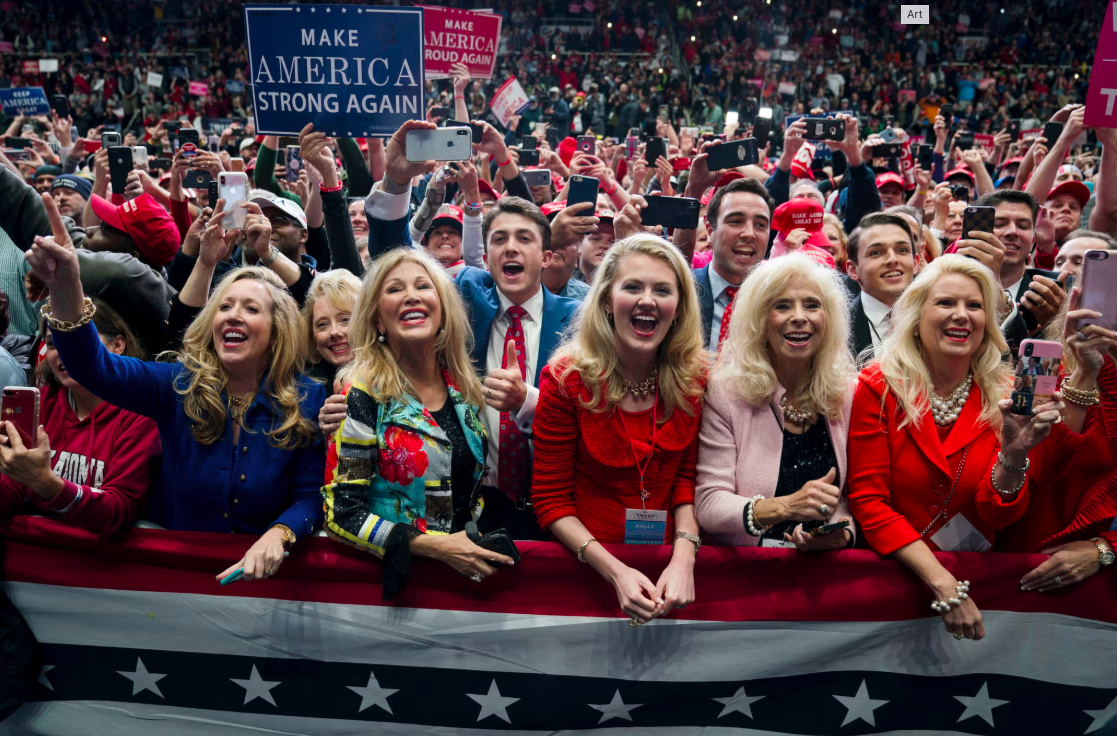
This is upstream of social media’s promise that it would make democracy fun; that indeed, making democracy fun was crucial to luring the bovine masses into participating in democracy at all. What this has turned into instead is a treatment of fun as civic participation in and of itself, which is well-illustrated in the sort of frenzied delirium you tend to see in the background of Trump rallies. Have you seen the smiles on those people? They’re having the greatest time. They experience a Trump rally the same way you’re supposed to experience a game show. In fact, everything the Trump administration does is from an argument of fun: Trump is a physical totem of the nouveau riche 1980s and all their selfish wastefulness, the codification of greed as a virtue thinly shrouded by a willful if sloppy insistence that people will naturally cooperate and treat each other with respect if they’re focused on their own individualized capacity to have the most superficial fun. This is how we ended up in a society where entertainment value confers both credibility and an eternal excuse for misbehavior. Nobody’s actually racist, sexist, bigoted, cruel, this is all just for the show. Besides, if people online are racist, sexist, bigoted, cruel, is this not simply a reflection of who people really are behind closed doors? Isn’t it better for all that stuff to be out in the open? Either way, I think we can all agree this is all very important for Staying Informed.
The reason this is relevant is because I think it’s important to recognize that the internet biases us toward thinking of entertainment as the only legitimate political vehicle even when we think we know better. Social media in particular prioritizes and reifies personal rather than system-focused thoughts and expressions about events like this. It’s the reason the internet is so allergic to unresolvable truths, which cannot help but affect how people talk about Jacob. The idea that sexual assault is a crime for which the offender is personally liable is not at all incompatible with an understanding that if society tolerates certain crimes for long enough, many more people will end up committing those crimes than otherwise would, and that that may very well be the case for him, and we simply can't know either way. But social media offers scant opportunity to hold these two ideas at once. Sadness and frustration are not very entertaining. We want there to be a solution for this guy that we can all come to a consensus on because we're all equal stakeholders in what happens in our favorite online spaces.
But that last bit, this assumed responsibility of the audience, is, I think, an impulse borne from a reflexive acceptance of the purpose social media demands we recognize it for, this "democratization of speech" pigshit. Just because there’s a running conversation on social media about every single imaginable thing doesn’t mean the conversation is always important for the way that thing manifests in real life. It is a delusion of agency at best to suggest, as I’ve seen a lot of people do, that the pain, anger, and disappointment people are expressing in response to this is some kind of cruel obstruction of restorative justice. A social media audience can be neither “rehabilitative” nor “carceral” because a social media audience does not have institutional power. Despite what social media would like us to believe, that power still belongs only to organizations with legal stakes and the teeth to pursue those stakes—the government, schools, businesses—with these last two gradually being asked over the past several decades to adopt more and more responsibilities that they are not equipped to handle because they used to belong to the government, such as adjudicating crime.
At the same time, I have seen others talk about this event in terms of personal betrayal, and while that's a reasonable way to feel, I think it’s important we all recognize there’s a difference between a betrayal of goodwill toward a stranger and a betrayal of a personal or business relationship. Audience members are neither Jacob Geller’s victim nor his employer. Even supporting him on Patreon is a thing apart from actually knowing or hiring him. The audience’s stake in his work is a matter of personal enjoyment and intellectual fulfillment; it is not, as is the case with many other people who know him, a matter of livelihood. The only people who can truly claim to be “betrayed” by him to the full extent of the word are the person he assaulted and the people who were close enough to be in his blast radius: his publisher, Nebula, MinnMax, and the fellow creators he collaborated with.
The hierarchy and gatekeeping involved in traditional mass media is imperfect at best and malevolent at worst, but it does at least close off any opportunity to think of it as “neutral” or “democratic” in the way social media does in order to occlude its own responsibilities. True, Nebula is not open to all, creators must be approved of internally by management and other creators, but you know what Nebula doesn’t have? Bots. It isn’t swarming with AI and exploitation and grifting. Most importantly, it has an interest in displaying intolerance for abuse. Nebula is structurally responsive to the needs and desires of its creators, all of whom benefit from a good work environment, which is why they were so quick to respond to this event in the first place. Such is the benefit of a co-op model. Oh shit, maybe we could scale that.
The reality is that social media is not in any meaningful sense very different from the media technologies that preceded it. It's just bigger. This is especially true for YouTube, which is in both form and function basically just a TV studio with no sets, cameras, or producers. In our abstract pursuit of a magical autopiloted democracy machine, we have credulously permitted business conditions that allow companies to make and sell products that are simply bad; dysfunctional, damaging to their users, and poorly defined, an industrial pattern now being repeated with AI. Social media is a media business like any other, and we need to regulate it and treat it in daily life as such. If your work is online, then you are a media brand, full stop. There's nothing special about the internet that magically makes the industrial realities of media disappear. It’s disturbing to me how many people still seem to think the internet is possessed of some kind of charm that nullifies a public figure’s requirement to perform decency and account for their actions, in their past as well as their present and future. Or even worse, that this nullification is somehow necessary for social media to be “honest.” It's disturbing, but I understand it. It's the grotesque body, the carnival, it’s the only way people can make sense of the corporate imperative to differentiate social media from all of the media that’s come before, a prerequisite for thinking of social media as societally necessary in specifically its current, Wild West form. The many points of failure in traditional mass media, its arbitrary gatekeeping and tendency toward elitism, are not solved by simply removing all regulation and admonishing people as authoritarian for asking what accountability looks like in such a system. “No unnatural authorities except capital” is not anarchism in any serious way.
If we genuinely want to catch things like past assault before they become a problem, then we need to stop treating it like a matter of individual consumer choice and start talking about it systemically, in how digital media economies function as well as the broader sociosexual politics that led Jacob to do what he did back in college. Whether the platform respects them as such or not, it's past time YouTubers started taking themselves seriously as media professionals and asking the same of their audiences. I'm not sure what the future of this will look like in practice, but I am certain it will require creators to approach the way platforms arrange information with more care than we have been used to over the past 10 years or so, including me. Digital media is slowly building out professional infrastructure despite YouTube, and so far in this case it’s only that infrastructure that has been able to respond materially to this event. If you were applying to be a news anchor, or you were an actor trying to get representation, being suspended for sexual assault in college is the kind of thing you would disclose as a matter of professional courtesy, for the precise reason that if and when it gets out, you risk materially harming a lot of people who have hitched their wagon to you. Jacob Geller was a flagship creator for Nebula and a growing personality in the North Carolina art and education scene, and now all those places have to do damage control and are set back by this. Despite the pain this has caused within these various systems, it’s only the existence of those systems that has resulted in professional consequences for an act that Jacob allowed to become a professional transgression. I have some sympathy for the conjecture of him maybe not foreseeing this when YouTube was still new and hyper-casual, but the days of video creators living in a hermetically sealed bubble where their actions only affect themselves are over. It is both foolish and depressive to the potential of digital media to pretend “authenticity” depends on naturalizing this warped individualism that rejects accountability on some sort of vague privacy principle but then, ironically, encourages us to pry into people’s inner lives in order to find an explanation or excuse for their actions (as I, because these are the modalities available to us, just did).
It’s not Nebula’s responsibility to make sure Jacob Geller can support himself. If you’re so concerned about his access to food and housing, advocate for social programs. Neither is it YouTube’s responsibility to make sure Jacob Geller can participate in society, and its pretensions of doing so should almost certainly be stopped. Societal participation must not remain synonymous with social media’s ability to sell ads. Unfortunately, our regulatory environment and the social conditions that feed into it have allowed YouTube to position itself as responsible for the benefits of its completely unregulated media empire but not the liabilities. We need to rediscover that the proper role of a business is to be reactive to demand in pursuit of its market, not proactive in issues of morality and ethics. You may contend that this is exactly what YouTube does as an amoral money-hungry leviathan, but no. YouTube is a functional monopoly, and as such has no incentive to respond to public demand at all. Hence it and the other social media platforms' cloying appeal to "free speech," a posture whose nobility they have used in successful marginalization of their refusal to deliver a consistently good product. Only the profit pursuit remains as a definite goal with identifiable benchmarks, and given enough time, say, the 25 years or so that it takes for a society run by a cynical profit-seeking ideology to produce a full-grown Mark Zuckerberg or Elon Musk, the profit pursuit itself becomes a proactive moral and ethical claim. It becomes horrifyingly sincere, this metaphysical faith in profit. This eventuality is what made business something of a shameful and vulgar pursuit to previous generations, a position I think it must regain if we want businesses to be at all beneficial to society. This requires that we maintain a clear eye about what businesses are and are not capable of achieving, and remember that there is a difference between a business and a human being (the erasure of the line between the two being another neoliberal ambition).
The world is full of obscene violations right now, all of them laundered through a rapacious analysis of supply and demand whose balance in the absence of regulation or institutional oversight (“supply” and “demand” being relative rather than fixed objects), is subject to motivated interpretation, and so always seems to end up favoring the already powerful. This and the suite of future laws and professional conventions designed to stop it, not speculation over the details of an assault involving strangers, needs to be the focus of how we talk about this and similar situations.
Wishing everybody involved and anybody reading this peace in these crazy days.