Top 5 Movies of 2025
By necessity every movie we see is made a couple of years too soon. By that I just mean that the societal commentary we tend to perceive in movies was not necessarily there at the movie’s inception. The fact that Superman and One Battle After Another felt like extremely on-the-nose metaphors for the current administration’s special brand of juvenile cruelty is an emergent quality; without an audience a piece of art is just a personal exercise in craft. The audience is a base ingredient in art, but the fact that they're the thing that’s added last means audiences are the most volatile variable in filmmaking. Being run primarily by Very Smart Business Boys, this is unacceptable to the film industry, which in recent decades has tried to correct for the unpredictability of audiences by reinventing the audience as customers instead of co-creators. Hundreds of millions of dollars are now poured into movies just to manage expectations, an entire technosocioeconocultural media apparatus moving millions of people and things to and fro, all for the benefit of not giving the audience anything to feel too bad or too good about. There’s a stench of desperation that wafts off this treatment of art, the same kind you get from overindulgent parents with tyrant children: the film industry is scared of its audience.
This is insulting, because audiences are (mostly) not children. Even audiences that actually are children instinctively want to participate in the imaginative process a healthy human automatically expects stories to offer, not just consume it as material evidence that mommy and daddy love us very much. Do you hear me, Disney? Netflix? Universal? You’re not my mom.
The kind of unholy equilibrium this creates, where the film industry obsequiously feeds as much candy as possible to audiences that grow more cantankerous and impatient by the day, can only be disrupted by truly urgent existential societal issues, the kind of stuff that demands audiences think very hard despite themselves about what they value and why. We will do this in the absence of good art, but I think it’s also the case that when audiences regain their own intellectual and emotional agency, good art will suddenly emerge in the weft of reality as if it were made specifically for the moment. Speaking of superlative lists, 2025 was probably in the top dozen worst years of American history (though so far 2026 threatens to knock it out of the running). On the other hand, good golly it’s amazing what civil unrest will do for a culture industry.
In typical fashion I missed a lot of movies this year that I know are good (Wake Up Dead Man; Mickey 17; No Other Choice). As always, I won’t claim that these movies are the objective “best” of what we got this year, I don’t even know how you would quantify such a thing and have no interest in trying. But I do think that these movies are made special because of the world they were born into and the reception that completed their existence. These are the ones that felt most to me like they were asking the audience to think about their own world, rather than telling them the real fun and sophistication is in escaping it.
Honorable Mentions:
The Phoenician Scheme
Superman
Frankenstein
Eddington
Caught Stealing
One Battle After Another
28 Years Later
Bugonia
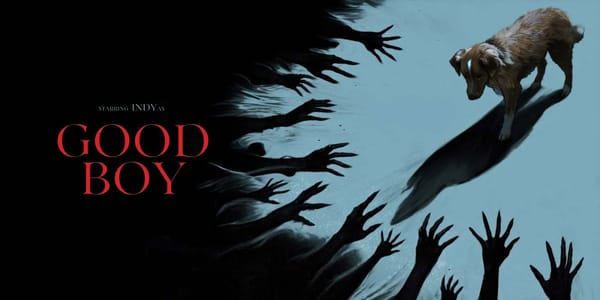
5. Good Boy
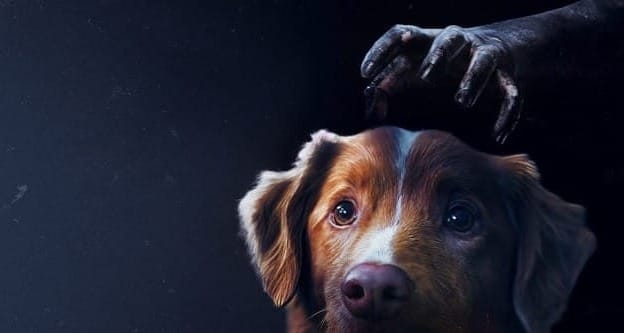
As a dog lover, movie lover, and dogs-in-movies lover, I was always going to think Good Boy was great. It’s such an obvious choice for this list that I’m almost embarrassed by it, but I think my credibility is rescued by the circumstances of its creation and reception (those circumstances being in all cases firmly part of what movies are doing, that’s the theme of 2025 filmmaking for me). It wasn’t just me, okay? Everybody loved this movie. Made for thousands of dollars instead of the small country’s GDP it takes most movies to get off the ground, Good Boy is an uncharacteristically humble monument to the qualities of filmmaking as an art that are difficult if not impossible to buy: thoughtful cinematography and editing, an intangible relationship of trust and care between actor and director, the creative benefits of inefficiency.
It's not that Good Boy is a perfect movie, necessarily. Its plot is slightly thin, its few effects a little rough. Indy The Dog has to jump through a window but we obviously can’t actually be flinging dogs through windows, so you’ll just have to pretend that the effect is a little better than your eyes are telling you. But these are artifacts of its aforementioned scale and care that I find more than acceptable. As far as I’m concerned it means the movie just has more incentive to make me buy the shortcomings.
Believe it or not, that used to be a standard expectation of and among audiences. As I’ve argued before, the monster from The Thing, famous for its practical effects, actually looks pretty silly out of context. But when you’re in the hands of a filmmaker who knows what their storytelling goal is and how to arrange everything onscreen in service of that goal, the human eye is more than willing to defer what it’s seeing to what the brain attached to that eye is feeling. We don’t go to movies to watch a software demo, and even if there weren’t still details of emotional expression too delicate and intimate for the mainstream film industry to render in ones and zeroes, those emotions would still have to be earned by the story and understood by its creator. In the case of Good Boy, the relevant emotional details have to do with the ways dogs express their devotion to their people, and the uncomfortable honor of receiving that devotion. The metatextual aspects of Good Boy, the relationship between this specific dog actor and his owner-director, are important to what this movie is doing. To try and tell this story in any other way would ruin the entire conceit. It would be like, oh, I don’t know, programming superficial adoration into a robot and calling it love.
4. Companion
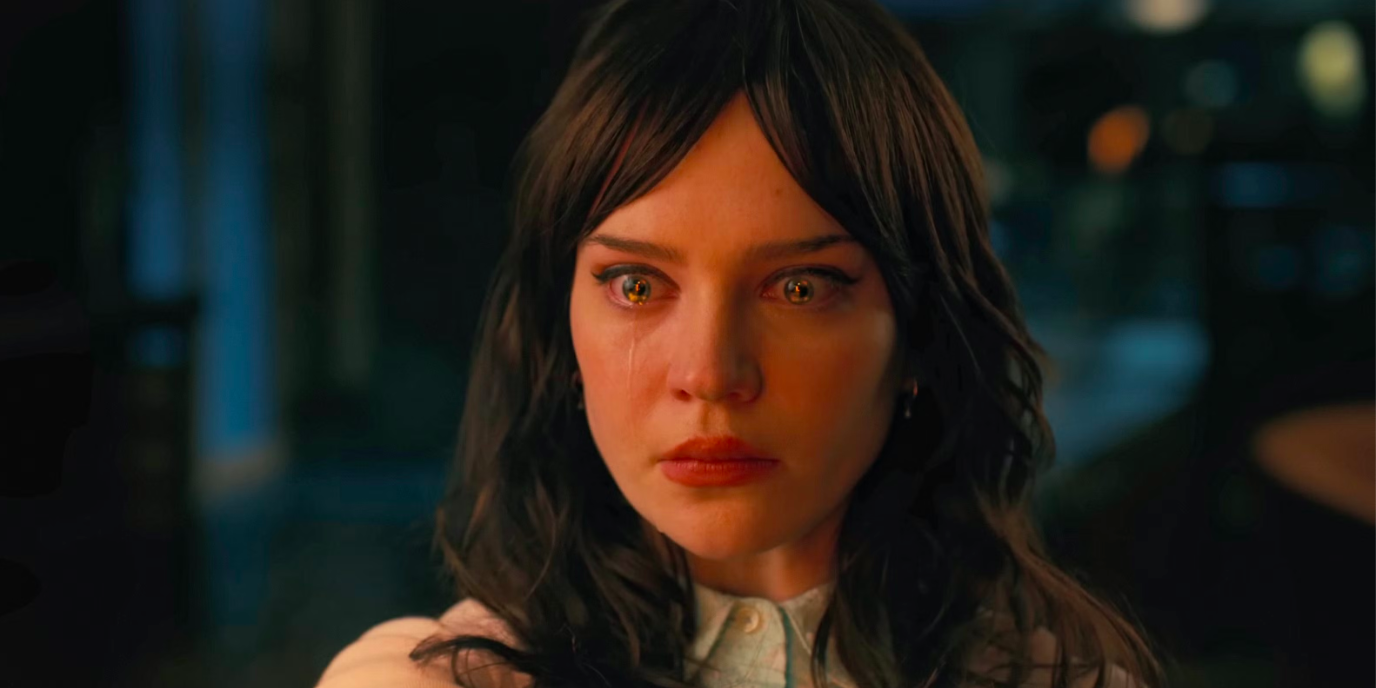
Every time there’s a shift in the technological status quo it must needs be inquired whether this is really mostly just a weird sex thing. In the AI sci-fi stories of previous generations, this topic has been deftly avoided. I think that’s because sci-fi about AI coups has been historically focused on using the robot as a vehicle to explore more high-minded aspects of the general human condition, such as which kinds of pleasure and pain we’re willing to outsource and what kind of effect that would have on us. Would it degrade us? Make us more isolated? Suspicious of each other? When the robots inevitably take over would we even have the wherewithal to notice?? Whatever the approach, the real-life human tendency to address every new technology in terms of how it might help us fuck is a topic so seedy and lurid that to address it head-on has historically seemed beneath the genre.
If you haven’t seen Companion, it’s tempting to assume that this refined/obscene dichotomy should define its approach to the topic. A lot of critics seemed to make this assumption, accusing it, as Jesse Hassinger at the AV Club did, of essentially not being kinky enough for a sex robot story. That’s because this is not a kink story. “Kink” and “weird sex thing” are not synonyms. The former is about fun, the latter is about power. Companion is a story about the kind of gendered exploitation and domination that only humans can produce, whether robots exist or not. The robot in this scenario is just a representation of the specific kind of noxious form those eternal social pathologies are taking right now. Aside from that, this movie is the best swing I’ve yet seen at making absolutely plain the problem with AI that all the tech oligarchs obsessed with replicating the aesthetic markers of sci-fi without understanding their narrative function refuse to see: if artificial general intelligence is achieved, then you have made a person, and a person has rights. There is no such thing as slavery without the evil relationship particular to a master and a slave, because slavery requires that the slave understand a human experience enough to seamlessly facilitate it without being able to access it themself. That is a dynamic we have at least claimed to consider a crime in all cases. The fact that this idea—that understanding a human experience means you are functionally human—is so new to us that we haven’t even begun incorporating it into our ethical systems is a sign of how far we have to go before we ever have a civilization worth defending unequivocally.
Personally I think that’s cause for celebration. Look here: it is a good thing when unknown unknowns transform into known unknowns. We’re entering a new age of…something, and if there’s anything clear about what happens next with AI, it’s that the future will adjust the thoughts that are available to have about technologies that claim to understand human consciousness enough to fully domesticate it, thoughts that look less abstract and chrome and more solid and organic. Maybe the real implication for the human experience is less about how the robot treats us and more about how we treat the robot. Maybe robotic-ness in the way we generally conceptualize it—coldly rational, utilitarian, concerned only with order and efficiency— is actually a negative quality possessed by humans, rather than a positive quality possessed by machines, who, after all, can only do what we tell them to do. Companion suggests that the desire to produce a frictionless world is the product of human beings who have pathologically rejected what it means to be human, and cannot not be blamed on the things we create to fulfill that desire. This movie predicted with clarity exactly what we’ve come to learn since its release early in the year from the brave innovations driving OpenAI’s sycophant bot that so many seem to reflexively gender female, Razer’s e-girl in a jar, and pretty much everything Grok has been doing in the past couple of months over at X, The Everything App: yeah, it’s really mostly just a weird sex thing.
3. Weapons
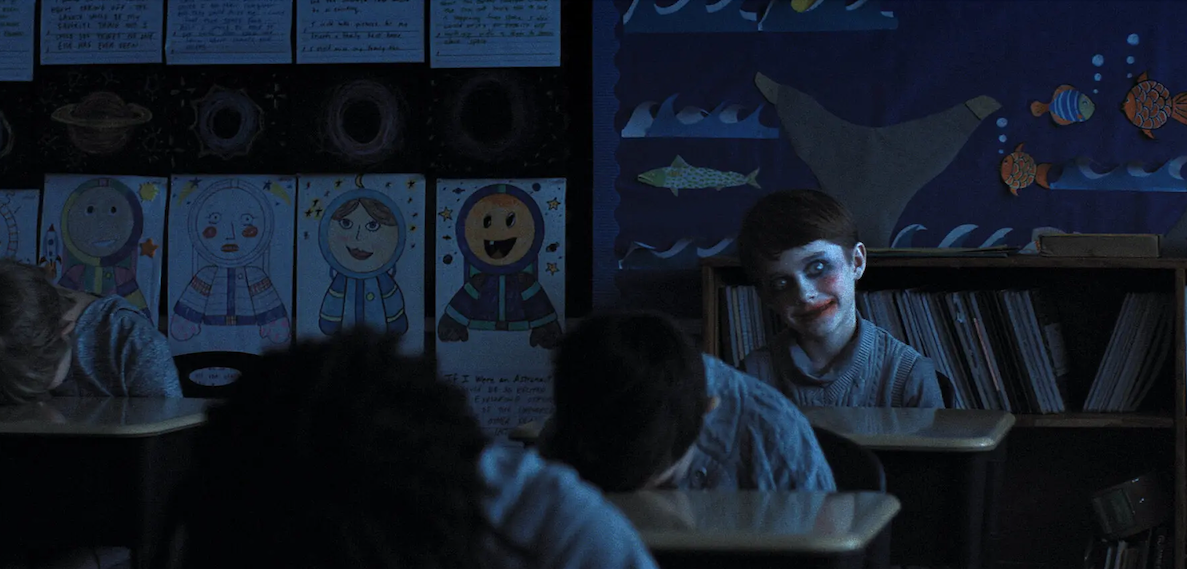
The time of the zombie has returned. Zombies have transformed so much over the decades that the fact that Zack Cregger’s Weapons is a zombie movie hardly seemed to register among audiences. Most of us think of the word ‘zombie’ as implying ‘horde,’ the Walking Dead type of dystopian anxiety that turned swiftly into a target-practice fantasy. There is indeed a pack of raging violent ghouls in Weapons, human shapes animated by an inhuman force, but rather than being the anonymous bodies available to be cut down by intrepid survivors, these zombies are the children whose disappearance and the grief and worry caused by it has rippled through the town of Maybrook in a way that causes all of the pain of a zombie outbreak without even the wild freedom implied by societal collapse. Everybody must continue living their lives, going to work, managing their personal dramas, in the wake of this unbearable and impenetrable mystery.
There are all sorts of interpretive directions you could take this, and as with any good story, all of them are correct to some degree. Weapons can be saying things about school shootings if that’s what you want it to do. But understanding this movie through the lens of direct allegory (again, as with any good story) isn’t likely to get you far. People who favored the school shooting reading didn’t know what to do with the semi-comedic tone of this movie. School shootings aren’t funny, but Weapons is. The movie failed?? The movie is incoherent??
No, stupid. Weapons is funny because the conditions that define the lives of the people of Maybrook—economic, cultural, personal—arrange their relationships to each other in a way that can only result in foolishness. Everybody in this movie thinks it’s a movie about them, that their personal journey is what really matters in the inexplicable disappearance of a class of elementary school kids. The witch responsible, whose frail, clownish self is in every physical way an unformidable force, depends on her parasitic manipulation of a social framework that predates her appearance in the town to achieve her ends.
In that way, I guess Weapons isn’t quite a back-to-basics zombie story, but that’s only because we in the modern day are still in denial about what kinds of freedom are actually available to us. The African diaspora that invented zombies as part of the voodoo tradition were slaves. To them, a zombie wasn’t some external invading force, but a very real and personal possibility of having one’s social context and agency stripped away and usurped by someone else’s greedy whim. As such, they understood in a way we’re still relearning that zombies aren’t born, they’re made. It’s a condition that’s inflicted upon human beings by someone, on purpose, turning us into creatures whose movements are not completely our own. Actually addressing that in real life means acknowledging that the individual heroism we imagine will solve a zombie outbreak is fanciful nonsense. In a world where zombies exist, either you’re controlling them, or you are them. Either position turns you into something grotesque, decadent, and, more than anything, ridiculous.
2. Pluribus
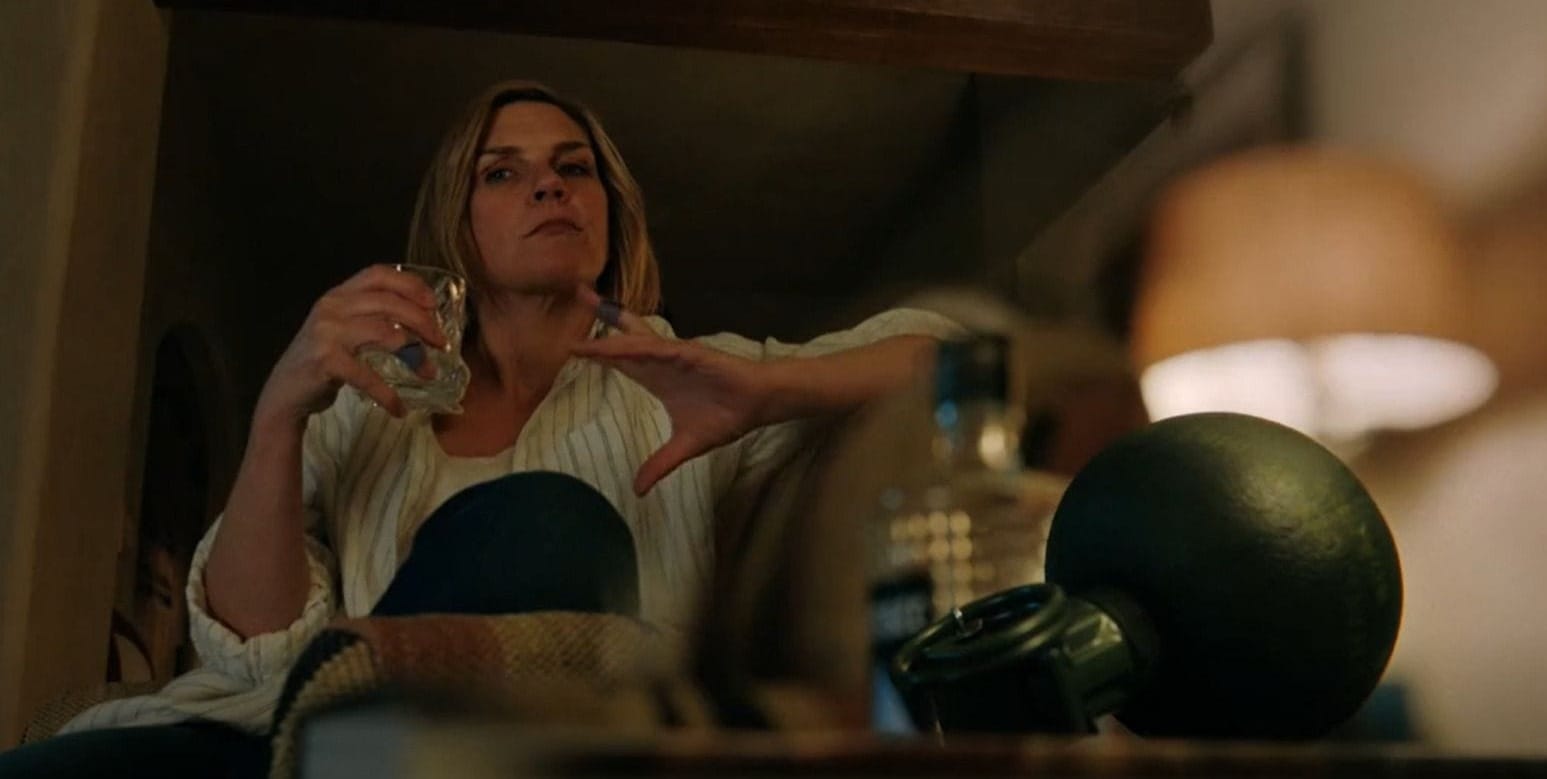
“But Pluribus isn’t a movie!” I know, just expand your definitions long enough to humor me. The only real differences between movies and TV are runtime and distribution method and I think those are pretty trivial differences when the text at hand is as large in scope and precise in intention as Pluribus is.
In keeping with our theme of art that’s affected by its reception, when Pluribus started airing, it was almost immediately diagnosed as a rumination over AI—the hive mind (named, for convenience, “The World”) that takes over humanity is a melding of all existing human thought, conciliatory and helpful to a fault at the same time as it purposefully limits the kinds of lives that are available for people to lead.
In my opinion, once again this allegorical interpretation falls apart almost immediately. Unlike AI, The World is a person. The World is all people, in fact. The World is the reasonable expectation of what would happen if all humans could instantly understand and respect each other’s thoughts, emotions, and experiences as easily as we do our own. It’s a realization of the image all utopian ideologies have of themselves. The more salient question, then, is not “how do we beat the hive mind?” but “why is a hive mind bad?” This is a more complicated question than the standard American approach has historically been able to address. When Carol meets the handful of people who like her are immune to the hivemind virus, not a single one of whom is white or wealthy, as she is, we’re forced to consider a couple of things at once: first, that Carol’s very explicitly American impulse to consider herself the main character of reality and expect the others to dutifully sign onto her campaign to defeat The World fails to consider that this hivemind scenario that seems so dystopian to her might be a marked improvement for some people. Second, that the same differences between individuals that in so many cases cause conflict and strife can, in other situations, reveal themselves as a priceless treasure. The opportunity to know other people as individuals with their own thoughts and perspectives that you can only learn by talking and living with them is an amazing opportunity that we take for granted every day, and that Carol has little ability to appreciate for many reasons both in and out of her control. The World might be happy, but it’s also sterile and inert, and that’s why a hive mind is bad.
Approaching this premise as Vince Gilligan does, with fearless care and respect for the story’s powerful, invasive antagonist, speaks to me of the transitional era we’re in. I don’t think it’s too dramatic to say that the world order of the 20th century has clearly failed, and we who benefitted from that order are now in the horrifying, humiliating position of reconsidering whether the things we value are based more in genuine moral consideration or a kind of unhappy juvenile tantrum. Vince Gilligan makes shows that do that thing only masters of storytelling can accomplish: unpredictability that, once everything unfolds, feels like it couldn’t have gone any other way. His shows feel like they write themselves. It’s hard to tell where Pluribus will end up, but hard to doubt that whenever and however it ends, we’ll know more about who we are, and who we’re going to be.
1. Sinners
Film has always had archival aspirations. Most communication technologies begin this way, as artifacts designed to catalog the world, turn it into something that can be reliably understood as “real,” free of all our interpretive pitfalls. This inclination doesn’t go away when a medium is reinvented as artistic. In fact, as the past century of American soft power has shown, art is often a vehicle for establishing the “correct” way for people to interpret their socio-cultural surroundings. This is, itself, a value-neutral fact, a dynamic that can be deployed toward all sorts of pro-social interpretations of history. The long list of Holocaust movies we as a species have produced in the past several decades has had a large hand in stabilizing a particular understanding of that event—not just the raw facts of what happened at a particular time and place, but what those events felt like to live through, and what they continue to mean for Jews as a people and for society as a whole.
This quality of film as a medium has two edges, though, and for people whose personhood has always been contingent and ambivalent in service of a particular status quo, this archival pretense in the history of American film can be less of a call to attention and more a device for evading responsibility. This is how white savior movies happen, where the audience is invited to identify with the boldness and bravery of a good white rather than the same qualities in nonwhite victims of oppression. Personally, I think there’s a direct genealogy between these cultural products and the common modern right-wing argument that women should be grateful to men and nonwhite people grateful to white people for “giving them rights.”
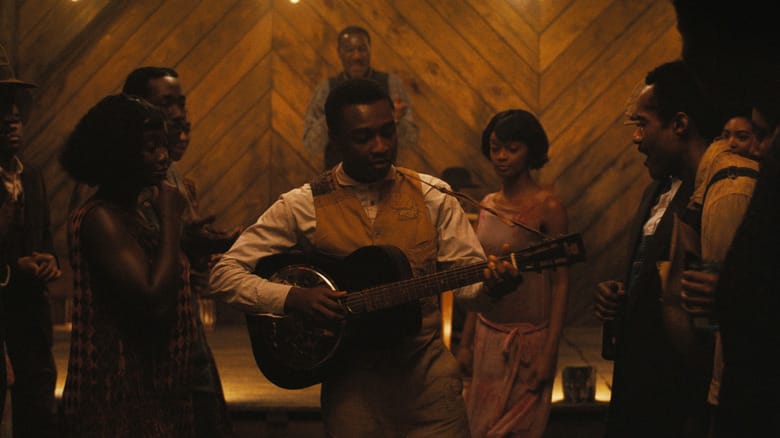
It’s an attitude perfectly amenable to the parasitic approach to culture that has always driven elite circles: in a culturally stratified society, art must go through a conversion pipeline that frames previous generations of art as subject to a kind of folk archaeology—the beauty and value of certain styles can only be recognized after the fact by learned sophisticates, who generously render the art safe now that everyone who contributed to its genesis is dead. This is largely what happened to blues and jazz, which has been historically laundered of all its darkness into something sterile and packageable for sale. As a result, these are genres we’ve lost at least some of our ability to hear in the way they were written and received in the underclasses they emerged from. So to see Ryan Coogler slice through the standards of the predatory industry his own art is subject to and arrange the history of black music in a way that places it undeniably and palpably back into the hands of the people who own it is, to me, nothing short of sorcery, the kind of instant shock of transcendent understanding art is meant to conjure. Coogler is self-conscious of this to the point of shamelessly lecturing the audience. “It’s magic, what we do,” intones aging blues player Delta Slim to his mentee Sammie. “It’s sacred, and it’s big.”
The vampires who attack in the scene that follows similarly return the vampire myth to the spiritual threat they originally represented. Both contemptible and deeply sympathetic, they are their own ghosts, people who long for and feed off the creations of others but are incapable of actually being nourished by the things they steal. To them, art is not about communion, but possession, an attitude shared both by capitalist commodification and by the predatory authoritarianism we call fascism. To the extent that the grotesquely postmodern, nihilistic, morally vacuous contemporary right can be considered at all “conservative,” it is in their treatment of culture as an object not to embody or participate in, but to be encased in resin and worn as a badge of in-group identity.
We are beset by performative concern about the dangers of multiculturalism from these people, mewling and disingenuous appeals to “cultural preservation,” as if cultures are rare keystone species whose vulnerable gene pool must not be compromised (none of these people are ever concerned about actual vulnerable species, but it’s interesting to note that they have the capacity to understand the fundamentals of biodiversity when it serves them). They expect this rhetorical strategy to give you pause, to lure you with these soft-boy overtures of liberal pluralism into thinking of them as friends and allies. "Won’t you let me in? :( I just want everyone’s culture to be protected. :("
My hope is that Sinners and its success represents a collective movement toward a conscious and even aggressive rejection of such claims. When a vampire arrives at your door and tells you they’re worried about culture becoming diluted, the correct answer is, always has been, and always must be “oh my god, who gives a shit.” Who gives a shit whether a certain snapshot of English culture perseveres, or, for that matter, Chinese culture, or Italian culture, or Tongan culture, or Amazonian culture. To me, this concern is pretty clearly pretending to be a very urgent solution to a question nobody who actually makes or loves art is raising. What matters is surely not that cultures might die out, but how they die out; whether their death is natural, a process by which a given culture continues to live on through its influence on the new styles it births, or unnatural, which is to say purposefully extinguished through force, as in colonialism, or slaughtered, embalmed and put on display, as in commodification.
I have a hard time imagining any work of art that could express this better than the party Coogler imagines honest, true art as summoning in the hearts of its makers and audiences. With his talent, Sammie invokes all the artists who contributed to his particular style of music and the dances associated with it in the past and all he’ll contribute to in the future: funk guitar, Djembe drum, hip hop, rap and crip walking, trap and twerking, gospel, Zaouli, traditional Acholi dance, lindy hop, Mapouka, modern ballet. In a lot of ways, these styles are completely different. In a much bigger and more important way, they are all the exact same thing.
The vampires outside Smoke and Stack’s juke joint are having “fun” in a superficial way, but art isn’t all about fun. The vampires know this, otherwise they wouldn’t be so hungry. True art is dangerous, it is transgressive, subversive, seductive, sinful. This will be an important thing to remember in the coming years. Art is not a product; it is a natural right of the human animal, arguably the one from which all other rights derive. Either we make and receive art, or we stop being human. Through art, no matter how sophisticated or vulgar, we are afforded the inborn, daily, inalienable salvation Delta Slim describes:
“With this here ritual, we heal our people…and we be free.”